
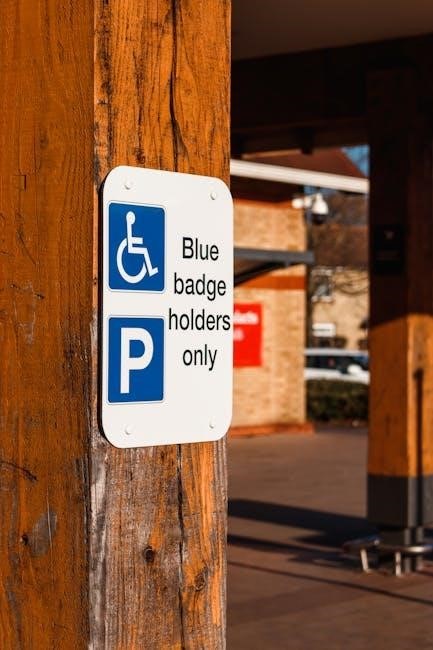
blue badge guide
What is a Blue Badge?
A Blue Badge is a permit aiding disabled individuals with parking needs, granting access to designated spaces closer to destinations.
The scheme’s history dates back to 1970, evolving to support those with both visible and, increasingly, non-visible disabilities.
Definition and Purpose
The Blue Badge scheme provides a nationally recognised permit allowing individuals with severe mobility issues to park closer to their destinations. This isn’t simply a convenience; it’s a vital aid enabling independent living and participation in everyday activities.
The primary purpose is to alleviate the difficulties faced by badge holders when travelling, reducing the physical strain and time required to reach essential services, employment, or social engagements. It aims to promote inclusivity and equal access for those with disabilities.
The badge allows parking in designated disabled spaces, and in many areas, offers exemptions from parking restrictions and charges, significantly improving accessibility for those who qualify.
History of the Blue Badge Scheme
The Blue Badge scheme originated in 1970, initially designed to assist war veterans with disabilities. Over time, its scope broadened to encompass a wider range of individuals facing significant mobility challenges. Early iterations focused primarily on physical impairments, offering a practical solution for parking access.
A significant evolution occurred in 2019, expanding eligibility criteria beyond visible disabilities. This landmark change acknowledged the challenges faced by individuals with non-visible conditions like Parkinson’s, dementia, and epilepsy, recognizing their equal need for accessible parking.
This expansion reflects a growing understanding of disability and a commitment to inclusivity, ensuring the scheme remains relevant and responsive to the diverse needs of the population. The scheme continues to adapt to modern challenges.

Eligibility Criteria for a Blue Badge
Eligibility hinges on significant mobility issues, qualifying through automatic conditions, PIP/DLA awards, Armed Forces compensation, or being a child aged three or over.
Automatically Qualifying Conditions
Individuals automatically qualify for a Blue Badge under specific circumstances, streamlining the application process. This includes those receiving the higher rate of the mobility component of Disability Living Allowance (DLA).
Furthermore, recipients of Personal Independence Payment (PIP) who score 8 points or more in the ‘moving around’ section are also automatically eligible.
A lump sum payment from the Armed Forces Compensation Scheme (tariffs 1 to 8), coupled with certification of a permanent and substantial disability impacting walking, also guarantees qualification.
Crucially, children aged 3 and over meeting specific mobility criteria are also included within these automatically qualifying conditions, ensuring accessibility for younger individuals.
PIP and DLA Qualification
Eligibility via Personal Independence Payment (PIP) is directly linked to the ‘moving around’ activity. Scoring 8 points or more within this section of the PIP assessment automatically qualifies an individual for a Blue Badge.
This reflects a significant level of difficulty with mobility, justifying the need for accessible parking provisions.
Similarly, the higher rate of the mobility component of Disability Living Allowance (DLA) serves as an automatic qualifying factor.
Both PIP and DLA assessments focus on an individual’s ability to safely and independently navigate, and meeting the specified criteria demonstrates substantial mobility challenges, warranting Blue Badge access.
Armed Forces Compensation Scheme
Veterans who have received a lump sum payment under the Armed Forces and Reserve Forces Compensation Scheme may be eligible for a Blue Badge, recognizing service-related disabilities.
Specifically, those awarded tariffs 1 to 8 within the scheme, and who have received certification confirming a permanent and substantial disability, qualify for consideration.
This disability must demonstrably cause either an inability to walk, or very considerable difficulty in walking, impacting their ability to access essential services.
The scheme acknowledges the sacrifices made by service personnel and provides crucial support through accessible parking provisions, enhancing their independence and quality of life.
Eligibility for Children (Aged 3+)
Blue Badges aren’t exclusively for adults; children aged 3 and over can also qualify, recognizing that disabilities manifest at any age and impact mobility significantly.
Eligibility for children is determined by the same criteria as adults, focusing on the severity of their mobility challenges and their ability to safely access transportation.
A child may qualify if they have a condition that causes considerable difficulty walking, even with assistance, or if they are severely mentally impaired with behavioral issues.
The badge supports families by easing parking difficulties, enabling access to essential medical appointments, educational opportunities, and social activities, improving the child’s overall wellbeing.
Non-Visible Disabilities – Expanded Criteria
Recent changes broadened Blue Badge eligibility beyond physical impairments, acknowledging the significant impact of non-visible conditions on mobility and daily life.
Conditions like Parkinson’s disease, dementia, epilepsy, and chronic fatigue are now considered, recognizing the substantial difficulties they pose in walking or navigating public spaces.
Applicants with these conditions must demonstrate that their disability meets specific criteria, proving it causes considerable difficulty walking, even with aids, or poses a risk to their safety.
This expansion aims to provide crucial support to a wider range of individuals, ensuring equitable access to parking and promoting independence for those with hidden disabilities.
The Application Process
Applying for a Blue Badge involves a process varying by local authority, typically requiring documentation and potentially an assessment to verify eligibility.
How to Apply – Local Authority Variations
The application process for a Blue Badge isn’t uniform across the UK; it differs significantly depending on your local council. Some authorities offer fully online applications, streamlining the process with digital form submissions and document uploads. Others still rely on postal applications, requiring printed forms and mailed supporting evidence.
Website navigation is key – each council’s website details its specific procedures, required forms, and contact information for assistance. Expect variations in the types of documentation accepted and the assessment methods employed. Some councils may offer telephone support to guide applicants through the process, while others prioritize online resources. It’s crucial to consult your local authority’s website directly for the most accurate and up-to-date instructions.
Required Documentation
Gathering the correct documentation is vital for a successful Blue Badge application. Typically, proof of identity, such as a driving license or passport, is required. Crucially, evidence of qualifying benefits is essential – this includes documentation relating to Personal Independence Payment (PIP), Disability Living Allowance (DLA), or awards from the Armed Forces Compensation Scheme (AFCS).
For PIP applicants, evidence of scoring 8 points or more in the ‘moving around’ section is necessary. DLA claimants need proof of receiving the higher rate mobility component. AFCS recipients must provide certification of a permanent and substantial disability resulting from their award (tariffs 1-8). Medical reports from healthcare professionals may also be requested to support your application, particularly for non-visible disabilities.
Assessment Process
The assessment process varies depending on your local authority, but generally involves evaluating your mobility needs and demonstrating significant difficulty walking. If you automatically qualify based on benefit receipt (PIP or DLA), the assessment may be streamlined, relying heavily on the existing benefit award details.
However, for those applying based on expanded criteria (non-visible disabilities), a more detailed assessment is likely. This could involve a physical assessment, review of medical evidence, and potentially an interview with an assessor. The focus is on how your disability impacts your ability to undertake journeys, not just your diagnosis. Local authorities aim to ensure fair and consistent evaluations, considering individual circumstances.
Blue Badge Usage and Regulations
Blue Badges allow parking in designated disabled spaces, and in some areas, on double yellow lines for limited times, but misuse carries penalties.
Permitted Use of the Badge
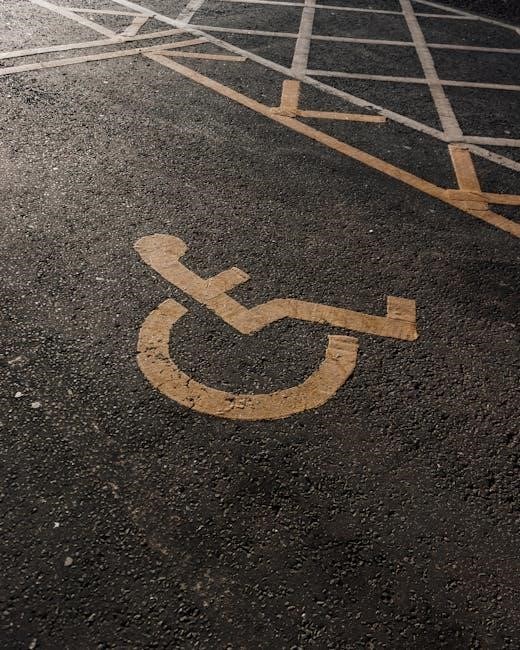
The Blue Badge permits parking in designated disabled parking spaces, offering crucial accessibility for badge holders. Beyond these spaces, badges are generally permitted on double yellow lines for up to three hours, unless restrictions are specifically indicated.
However, it’s vital to remember the badge is for the use of the individual to whom it’s issued, not for the convenience of others. Friends or relatives can only utilize the badge when actively traveling with the badge holder.
Parking regulations vary by local authority, so understanding specific rules for each area is essential. Misunderstanding these rules can lead to fines or badge confiscation, highlighting the importance of responsible usage.
Restrictions and Misuse
Blue Badges are strictly for the benefit of the named individual and cannot be used by anyone else, even for quick errands, unless the badge holder is present. Parking on double yellow lines is permitted for a limited time, but not where it would cause obstruction or danger to other road users.
Misuse includes allowing others to use the badge, altering or falsifying information, and using a stolen or expired badge. These actions are considered fraudulent and carry significant consequences.
The increasing prevalence of misuse has prompted calls for stricter enforcement and a crackdown on fake or stolen permits, demonstrating the need for vigilance and responsible badge ownership.
Penalties for Improper Use
Improper use of a Blue Badge can result in substantial fines, potentially reaching thousands of pounds. Local authorities have the power to confiscate misused badges, and repeat offenders may face criminal prosecution.
Beyond financial penalties, misuse can lead to a criminal record, impacting future opportunities. The severity of the penalty often depends on the nature of the offense – whether it’s a first-time violation or a deliberate act of fraud.
Authorities are actively cracking down on abuse, with increased surveillance and enforcement efforts. Reporting suspected misuse is crucial in deterring fraudulent activity and ensuring the scheme benefits those who genuinely need it.
Statistics and Trends
Currently, over 3.07 million Blue Badges are in circulation, representing an 8% increase year-over-year, with regional variations in holder proportions.
Number of Blue Badges in Circulation
As of recent data, the United Kingdom currently has over 3.07 million Blue Badges actively in use. This figure represents a notable increase of approximately 8% compared to the previous year’s statistics, indicating a growing demand for the scheme’s support. The distribution of these badges isn’t uniform across the country; regional disparities are evident.
The North East region currently demonstrates the highest proportion of Blue Badge holders, reaching 6.1% of the population. Conversely, London exhibits the lowest percentage, with only 3.5% of residents utilizing the scheme. These variations likely reflect differing demographic profiles, healthcare access, and awareness levels within each region. Continued monitoring of these numbers is crucial for effective resource allocation and policy adjustments.
Regional Variations in Badge Holders
Significant differences exist in Blue Badge ownership across the United Kingdom, reflecting varied regional needs and demographics. The North East consistently reports the highest concentration of badge holders, currently standing at 6.1% of the local population. This suggests potentially higher rates of disability or differing access to mobility support within the region.
In stark contrast, London displays the lowest proportion of badge holders, at just 3.5%. Factors contributing to this disparity may include greater reliance on public transport, differing socio-economic profiles, or potentially, under-reporting of eligibility. Understanding these regional nuances is vital for tailoring support services and ensuring equitable access to the Blue Badge scheme nationwide. Further investigation into these variations is warranted.
Growth in Blue Badge Numbers
Recent data reveals a consistent increase in the number of Blue Badges currently in circulation. As of recent reports, there are 3.07 million badges issued, representing an 8% rise compared to figures from the previous year. This substantial growth indicates an expanding awareness of the scheme and potentially, a growing number of individuals meeting the eligibility criteria.
The expansion of eligibility criteria in 2019, to include those with non-visible disabilities like Parkinson’s, dementia, and epilepsy, is a key driver of this increase. This broadened scope ensures more individuals receive the support they require. Continued monitoring of these numbers is crucial to assess the scheme’s effectiveness and ensure adequate resources are allocated to meet the evolving needs of badge holders.

Renewals and Reassessments
Blue Badges require periodic renewal and potential reassessment, ensuring continued eligibility based on evolving circumstances and ongoing need for support.
Renewal Frequency
The frequency of Blue Badge renewal varies depending on the issuing local authority and the type of badge. Generally, badges issued for a limited period – often due to temporary disabilities – require more frequent renewal than those granted for permanent conditions.
Most badges are issued for a maximum of three years, after which reassessment is typically required. Some authorities may offer renewal periods of one or two years initially, particularly if there’s uncertainty about the long-term nature of the disability.
It’s crucial to check the expiry date on your badge and initiate the renewal process well in advance to avoid any lapse in coverage. Local authorities usually send reminders, but responsibility ultimately lies with the badge holder to ensure timely renewal and continued access to disabled parking facilities.
Reassessment Procedures
Reassessment for Blue Badge renewal involves a review of the applicant’s current mobility and eligibility criteria. Local authorities employ various methods, including medical assessments conducted by healthcare professionals. These assessments evaluate the individual’s ability to walk, their reliance on assistance, and the impact of their disability on their daily life.
The process may involve submitting updated medical evidence from a GP or specialist, detailing the ongoing nature of the disability and its effect on mobility. Some authorities utilize a standardized assessment form, while others conduct in-person evaluations.
The goal is to ensure the badge remains appropriate for individuals with significant mobility challenges, and that resources are allocated effectively. A thorough reassessment helps maintain the integrity of the scheme and prevents misuse.
Changes in Circumstances
Badge holders must promptly notify their local authority of any significant changes in their circumstances that may affect their eligibility. This includes improvements in their mobility, a change in their medical condition, or a relocation to a different address.
Failure to report such changes can lead to the badge being revoked, and potential penalties for misuse. For example, if a condition improves and no longer meets the qualifying criteria, the badge should be surrendered.
Authorities may initiate a review if they receive information suggesting a change in circumstances. Proactive reporting demonstrates responsible badge usage and ensures the scheme benefits those who genuinely require it. Maintaining accurate records is crucial for both badge holders and administering authorities.

Combating Fraud and Misuse
Authorities are actively cracking down on fake and stolen Blue Badges, with increasing vigilance and penalties for illegal use, protecting the scheme’s integrity.
Crackdown on Fake and Stolen Permits
Recent years have seen a significant increase in efforts to combat Blue Badge fraud and misuse, driven by concerns over the growing number of invalid permits in circulation. Investigations reveal a troubling trend of forged badges and the illegal sale of legitimately issued permits.
Local authorities and law enforcement agencies are collaborating to identify and prosecute offenders, employing advanced detection methods and conducting regular checks in parking facilities. Penalties for possessing or using a fraudulent badge are substantial, including hefty fines and potential criminal prosecution.
The crackdown aims to safeguard the scheme for genuine badge holders, ensuring they can access essential parking provisions without obstruction. Public awareness campaigns also encourage reporting of suspected abuse, fostering a collective responsibility in protecting the integrity of the Blue Badge system.
Reporting Suspected Abuse
If you suspect someone is misusing a Blue Badge, reporting it is crucial to protect the scheme’s integrity and ensure legitimate badge holders benefit fully. Most local authorities provide dedicated channels for reporting suspected abuse, often available on their websites or via a direct contact number.
When reporting, provide as much detail as possible, including the badge number (if visible), vehicle registration, location, date, and time of the suspected misuse. Photographic or video evidence can be particularly helpful in supporting your report.
Reports are treated confidentially, and investigations are conducted to verify the information provided. By actively reporting suspected abuse, you contribute to deterring fraudulent activity and upholding the fairness of the Blue Badge system for those who genuinely need it.